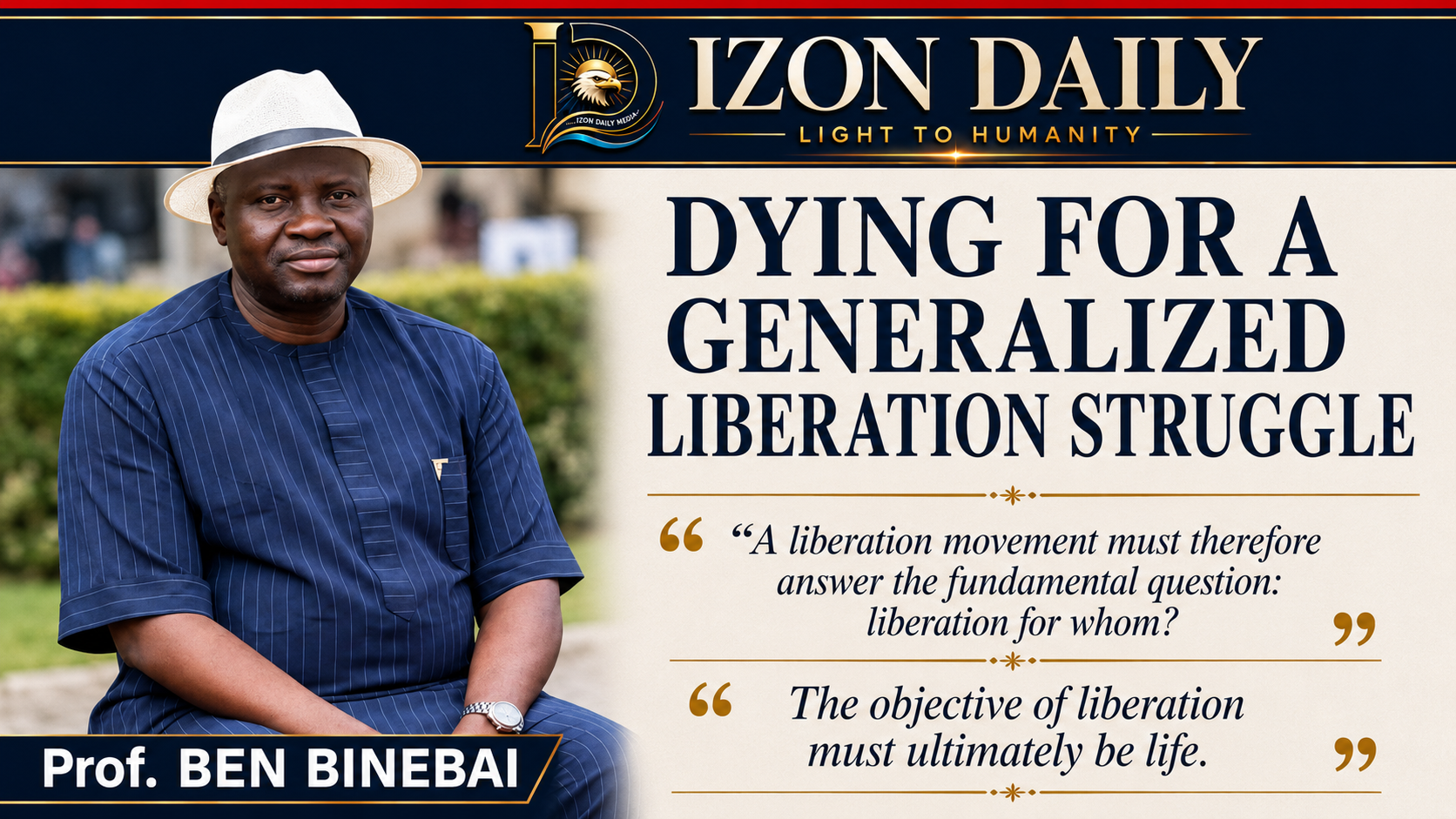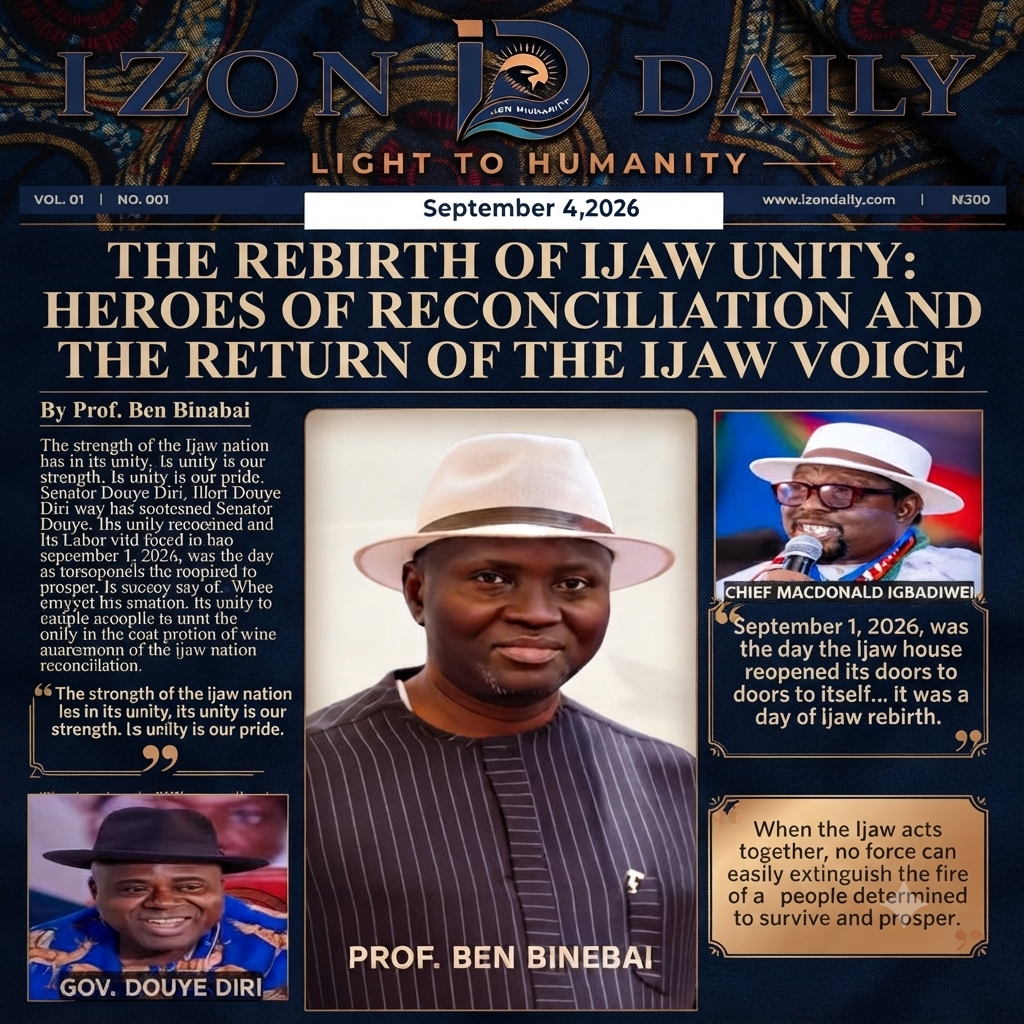
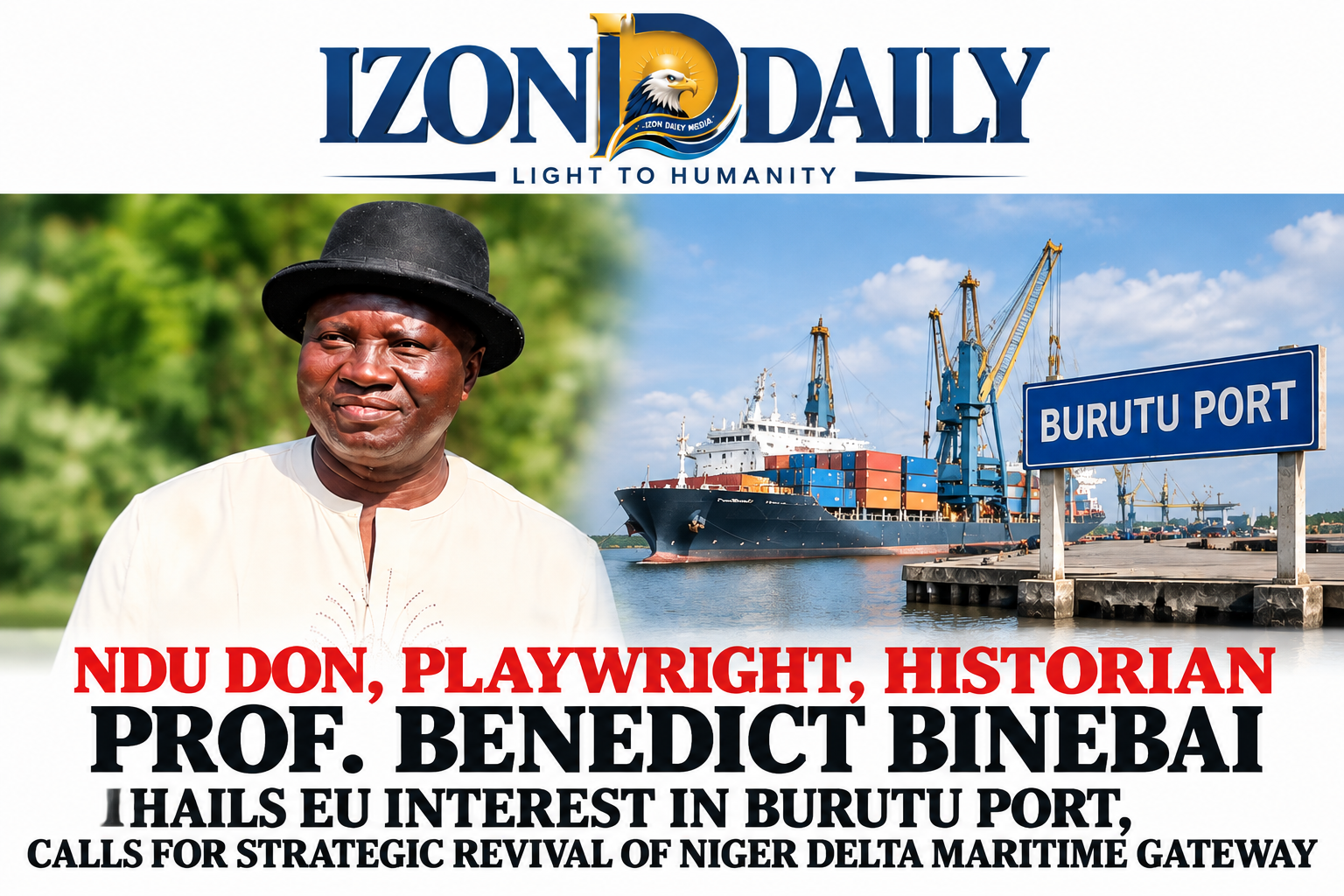
NDU DON, PLAYWRIGHT, HISTORIAN PROF. BENEDICT BINEBAI HAILS EU INTEREST IN BURUTU PORT, CALLS FOR STRATEGIC REVIVAL OF NIGER DELTA MARITIME GATEWAY
Renowned playwright, scholar and public affairs commentator, Profe. Benedict Binebai of Niger Delta University, Bayelsa State, has described the European Union’s interest in Burutu Port as a historic opportunity to restore the riverine community’s position in Nigeria’s maritime economy.
Binebai, in his reflection titled “Burutu: The Port Island Where History Meets the Future,” said the proposed Sea Link corridor linking Lagos, Burutu, the River Niger, Onitsha and Ajaokuta could transform Nigeria’s coastal and inland water transportation system if properly developed.
He noted that Burutu’s strategic location gives it the potential to serve as a major maritime gateway, creating opportunities in trade, logistics, marine education, employment and the blue economy.
The playwright and scholar recalled Burutu’s historic role in maritime commerce, while urging stakeholders, including Niger Delta institutions and community leaders, to ensure that any revival plan is backed by feasibility studies, transparency, environmental safeguards and meaningful community participation.
Binebai warned that the opportunity must not become another abandoned promise, stressing that Burutu’s maritime history should be transformed into a sustainable economic future.
𝗙𝗨𝗟𝗟 𝗦𝗧𝗔𝗧𝗘𝗠𝗘𝗡𝗧 𝗕𝗬 𝗣𝗥𝗢𝗙𝗘. 𝗕𝗘𝗡𝗘𝗗𝗜𝗖𝗧 𝗕𝗜𝗡𝗘𝗕𝗔𝗜
𝐁𝐮𝐫𝐮𝐭𝐮: 𝐓𝐡𝐞 𝐏𝐨𝐫𝐭 𝐈𝐬𝐥𝐚𝐧𝐝 𝐖𝐡𝐞𝐫𝐞 𝐇𝐢𝐬𝐭𝐨𝐫𝐲 𝐌𝐞𝐞𝐭𝐬 𝐭𝐡𝐞 𝐅𝐮𝐭𝐮𝐫𝐞
There are moments in the life of a place when history appears to return, not as a ghost of what once was, but as a promise of what can still become. The recent interest of the European Union in Burutu Port is one such moment. It is a recognition that Burutu is not merely another riverine community on the map of the Niger Delta; it occupies a strategic position where the Atlantic, the Niger Delta waterways and the great River Niger could potentially be woven into one maritime and economic corridor.
The proposed Sea Link should be understood as a coastal and inland-waterway transportation corridor, rather than simply a new port or a single piece of infrastructure. As currently described, the route would run from Lagos along the coastal corridor to Burutu and from Burutu continue up the River Niger through Onitsha towards Ajaokuta.
The concept is intended to shift part of the movement of goods from roads to coastal and river transportation, supported by barges, port facilities and related logistics infrastructure.
This gives Burutu a particularly important position. It could function not merely as a stop on the route but, subject to feasibility and rehabilitation, as the maritime gateway where ocean-going trade interfaces with inland water transportation.
The vision deserves to be hailed because it looks beyond the conventional geography of Nigerian transportation. It sees water as infrastructure, the river as a highway and Burutu as a natural meeting point between ocean-going commerce and inland navigation.
The history of Burutu Port is not a story waiting to be invented; it is a story waiting to be understood. From the era of the Royal Niger Company, through the United Africa Company and into the Nigerian Ports Authority, Burutu was associated with maritime commerce and river transportation.
But then came one of the darkest chapters in Burutu’s maritime history—the era of the Central Water Transportation Company. In the bitter memory of Burutu, this was not the arrival of a saviour but the arrival of an undertaker.
A port that had once throbbed with commercial life, received vessels, moved cargo and connected the Atlantic with the great waterways of the Niger was allegedly stripped of the very assets that sustained its existence.
The waterways that once carried Burutu’s prosperity may now carry the possibility of reconnecting it to a new generation of maritime commerce.
The proposed Sea Link is therefore more than a transportation concept. It raises the prospect of reopening an economic artery between the coast and Nigeria’s interior.
If properly studied, financed and executed, the corridor could facilitate the movement of agricultural and industrial goods, strengthen connections between coastal and inland communities and contribute to a more integrated blue economy.
This is also a moment for the major Ijaw and Niger Delta institutions to show strategic interest. PANDEF, the Ijaw National Congress and the Ijaw Youth Council should not regard the proposed Sea Link merely as a Burutu project, but as an opportunity with implications for the economic future of the wider Ijaw nation and the Niger Delta.
But history should teach caution as well as ambition. Any proposed development must be subjected to rigorous feasibility studies, cargo forecasts, cost-benefit analysis and transparent environmental and social assessments.
Burutu has already demonstrated what its location can mean to commerce. The question is no longer whether the town possesses the geography for a major maritime role—it plainly does. The question is whether Nigeria will finally match that geography with the infrastructure, investment, institutions and political commitment required to unlock it.
The proposed Sea Link should now be subjected to serious feasibility studies, transparent financing arrangements, environmental and social safeguards, and a clear implementation framework involving the Federal Government, Delta State, investors and the communities along the corridor.
History has already shown what happens when a strategic maritime asset is neglected, mismanaged or stripped of the systems that sustain it. Burutu should not be allowed to become another monument to abandoned possibilities.
The time has come to put Burutu back where its history, geography and maritime potential place it: at the centre of the conversation about Nigeria’s inland waterways, blue economy and regional trade.
This time, history must not merely be remembered. It must be put to work.