
The Ijaw quest for special attention was sufficiently compelling to impress the Henry Willink Commission, which advised the emerging Nigerian government that the Ijaw country should be treated as a “special area”. The purpose of this recommendation was to give the people “the opportunity for putting forward plans of their own for improvement.” The Commission further recommended the establishment of a Federal Board to address the peculiar problems of “the area of the Niger Delta”. The geographical reality behind this recommendation was principally the difficult terrain of the creeks, swamps and riverine settlements inhabited substantially by the Ijaw people. The recommendation was therefore an acknowledgement that the problems of the Ijaw country were sufficiently peculiar to require an exceptional developmental response.
The constitutional history that followed gave institutional expression to this recognition. The 1960 Nigerian Constitution provided for the establishment of the Niger Delta Development Board under Section 14, while the 1963 Republican Constitution subsequently gave the Board constitutional backing under Section 159. These provisions represented an early official recognition that the riverine Niger Delta possessed developmental problems that could not be adequately addressed through the ordinary machinery of government. The fundamental question was therefore not whether the Niger Delta required special intervention, but how such intervention could be designed to reach the communities that bore the greatest burden of geographical isolation, infrastructural neglect and resource exploitation.
Unfortunately, political calculation gradually transformed what was conceived as a targeted developmental intervention into a broad regional instrument. The peculiar grievances of the Ijaw country became increasingly subsumed under the general political vocabulary of the Niger Delta. In this transformation lies one of the most important paradoxes of the Ijaw struggle. A people whose particular circumstances had received special recognition found their claims progressively absorbed into a wider regional category. The language of generalisation became a political instrument through which specific grievances could be diluted, redistributed and, in some circumstances, politically neutralised.
This does not mean that the other peoples of the Niger Delta have no legitimate grievances. They do. The Ogoni, Itsekiri, Urhobo, Isoko, Ibibio, Efik, Ibeno and other communities of the region have their own histories of environmental degradation, political exclusion, resource injustice and developmental deprivation. Their struggles deserve recognition in their own right. The issue is rather that a regional umbrella should not erase the distinct historical experiences and territorial claims of the constituent peoples beneath it.
The Ijaw liberation struggle is, in this sense, a continuing project of decolonisation. It represents resistance to structures of political domination, economic extraction, cultural marginalisation and environmental dispossession. It is a rebellion against a political economy in which enormous wealth can be extracted from a territory while the people inhabiting that territory remain surrounded by poverty, ecological devastation and inadequate infrastructure. It is a struggle against institutionalised violence and the systematic denial of development.
Yet the struggle contains a profound strategic contradiction. The forces that have emerged in the name of Ijaw emancipation have frequently adopted the geographical identity of the Niger Delta. Their language, symbols and organisational names have therefore encouraged the Nigerian state and the international community to interpret an essentially Ijaw-driven struggle as a regional struggle. This has enlarged the political visibility of the movement, but it has also complicated the question of ownership, constituency and political destination.
The critical questions must therefore be asked without sentimentality. What exactly is the territory for which the Ijaw freedom fighter is struggling? Is the objective the emancipation of the Ijaw country, the political transformation of the entire Niger Delta, or a broader restructuring of the Nigerian federation? The Ijaw people are politically scattered across several states as a consequence of historical boundary-making and administrative balkanisation
Political liberation requires a clearly defined constituency, a clearly articulated grievance and a clearly identifiable political objective. A revolutionary movement without a clearly defined political destination can become trapped in perpetual resistance. It may possess courage, sacrifice and heroic narratives without achieving structural transformation. The history of liberation movements across the world demonstrates that moral legitimacy alone does not guarantee political success. Liberation must eventually be translated into institutions, constitutional arrangements, economic programmes and sustainable political power.
Harold Dappa-Biriye understood the strategic usefulness of the Niger Delta identity when he founded the Niger Delta Congress. Although Biriye was an Ijaw, the Niger Delta Congress sought a wider regional political constituency. That was the logic of electoral politics. A political party must construct coalitions across
communities. A liberation movement, however, may have a more specific constituency and a more sharply defined objective.
The distinction is important because political regionalism and ethnic self-determination are not necessarily identical projects. One may demand justice within a federation, while the other may seek greater autonomy, territorial reorganisation or self-determination. Confusing the two can create strategic uncertainty and make it difficult for both the Nigerian state and the international community to understand the precise nature of the claim.
The armed declaration of the Niger Delta Republic by Isaac Jasper Adaka Boro in 1966 represented one of the earliest dramatic expressions of this contradiction. Boro and his Niger Delta Volunteer Service emerged from profound grievances over the political and economic condition of the Ijaw area. His revolt was a declaration that the people of the region could no longer remain passive subjects of a political order that extracted resources from their environment without corresponding development.
Boro's historical significance lies not merely in the duration of his revolt, but in the political imagination behind it. He converted accumulated frustration into a declaration of political agency. He demonstrated that a marginalised people could transform their grievances into a political claim. His struggle entered the history of Nigeria as a landmark in the politics of resource control, minority rights and self-determination.
Later movements inherited elements of this political tradition. The Niger Delta Peoples Volunteer Force associated with Alhaji Mujahid Dokubo-Asari and the Movement for the Emancipation of the Niger Delta represented later phases of militant resistance in the oil-producing region. These movements emerged within a wider history of environmental devastation, political exclusion, resource control disputes and youth frustration. Their emergence demonstrated that the unresolved questions of Boro's generation had not disappeared; they had merely assumed new forms.
But here again the question of political nomenclature becomes important. When an Ijaw-led organisation bears the name of the Niger Delta, the world naturally interprets its demands as regional. The result is that the political identity of the Ijaw struggle becomes merged with the collective identity of the Niger Delta. This may create sympathy and strategic leverage, but it can also produce ambiguity about the ultimate beneficiary of the struggle.
The Ogoni experience provides a useful contrast. Ken Saro-Wiwa and the Movement for the Survival of the Ogoni People articulated a struggle whose geographical and political centre was unmistakably Ogoni. The Ogoni Bill of Rights presented the grievances of a particular people and demanded political, economic and environmental justice for Ogoniland. The movement's moral force was derived partly from the clarity of its constituency. The world knew who was speaking, where the grievance was located and what historical injustice was being challenged.
The lesson is not that the Ijaw struggle should become hostile to other Niger Delta peoples. The opposite is true. The lesson is that solidarity should not require the disappearance of identity. A regional coalition can contain distinct national, ethnic and community claims without pretending that all those claims are identical.
The danger of generalisation becomes particularly serious when the dividends of struggle are distributed regionally while the original centres of sacrifice remain underdeveloped. If communities that bear the greatest environmental, social and political costs of petroleum extraction do not experience corresponding developmental benefits, resentment will deepen. The question then becomes whether the political architecture created in the name of the Niger Delta actually reaches the communities whose sacrifices made the regional struggle possible.
The history of the Niger Delta Development Commission and other interventionist institutions must therefore be examined through the lens of distributional justice. The creation of a regional development institution is not in itself evidence of justice. The real test is whether its resources reach the places where deprivation is deepest, whether projects are sustainable, whether local communities participate in decision-making and whether development produces durable economic transformation.
The Ijaw people have often occupied the paradoxical position of being both central and marginal within the Niger Delta political equation. They inhabit an enormous portion of the riverine terrain from which petroleum resources are extracted, yet political boundaries have divided their communities among several states and administrative jurisdictions. This balkanisation has weakened territorial cohesion and complicated political representation.
The result is a peculiar form of political fragmentation. The people may share language, culture, historical memory and geographical relationships, while being separated by state boundaries and governed through political structures in which they are minorities. A people can therefore be territorially concentrated in one historical homeland and simultaneously politically dispersed across several contemporary administrative units.
This is why the Ijaw question cannot be reduced to the general vocabulary of “South-South development”. Developmental geography does not always correspond with administrative geography. The political map may divide communities that the river system, historical migration, kinship and cultural memory have connected for centuries.
The central grievance, therefore, is not simply that the Niger Delta is neglected. It is that the historical Ijaw homeland has experienced a peculiar combination of political fragmentation, environmental degradation, economic extraction and inadequate reinvestment. These conditions have generated a politics of frustration in which successive generations have repeatedly rediscovered the language of resistance.
This is where the expression “dying for a generalized liberation struggle” acquires its deepest meaning. It describes the tragedy of a people whose sons and daughters repeatedly become the human capital of regional resistance while the political dividends of that resistance are distributed far beyond the communities that supplied the greatest sacrifices.
The phrase should not be understood as a rejection of regional solidarity. It is a demand for strategic clarity. There is nothing wrong with an Ijaw struggle contributing to the emancipation of the wider Niger Delta. Indeed, the liberation of one oppressed community can strengthen the political consciousness of neighbouring communities. The problem arises when the particular becomes invisible within the general and when the original constituency becomes merely the foot soldier of a political project whose final destination remains undefined.
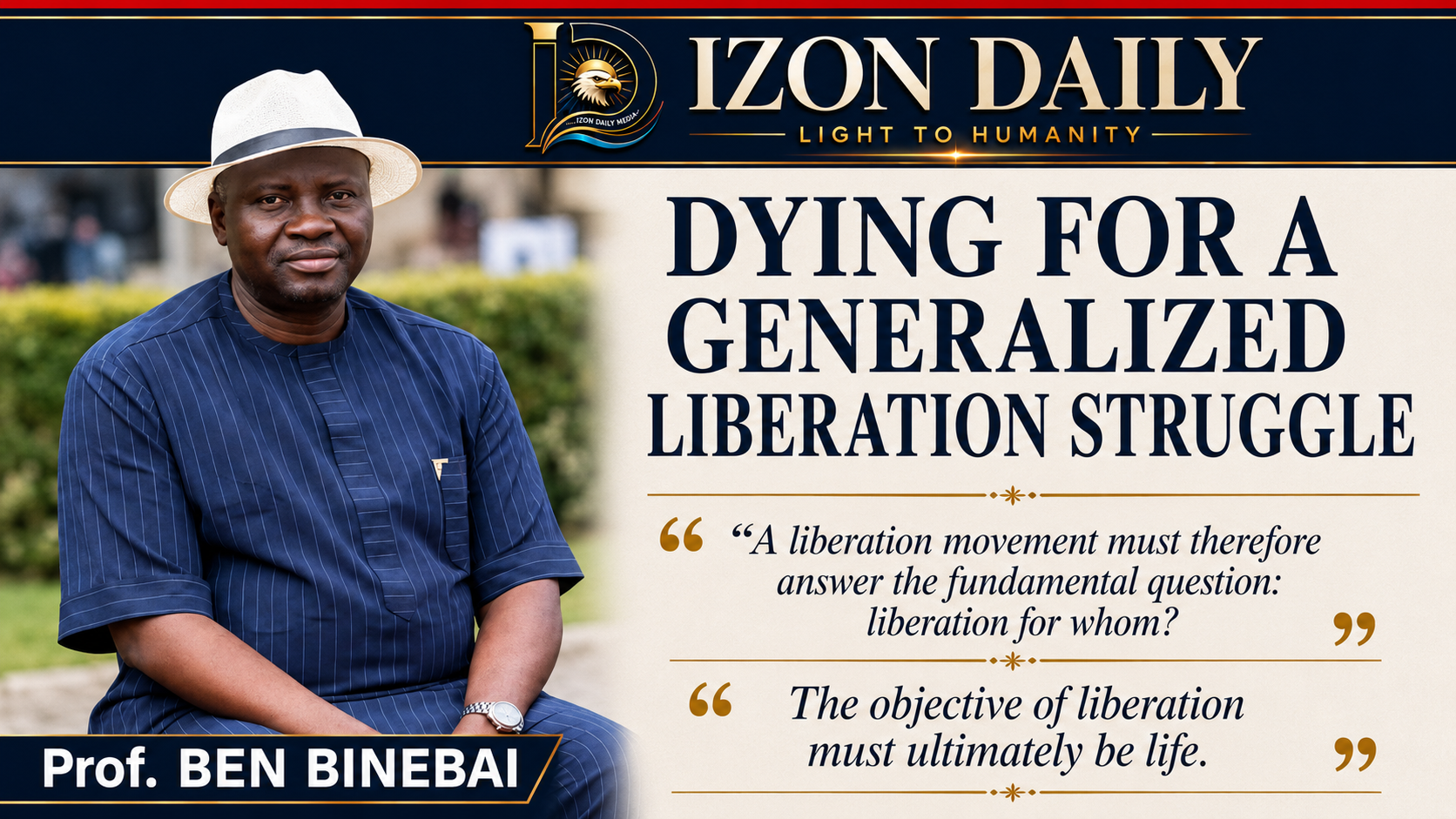
A liberation movement must therefore answer the fundamental question: liberation for whom?
The answer cannot remain permanently concealed beneath the broad and politically attractive expression “Niger Delta”. If the movement is fundamentally Ijaw in composition, history and sacrifice, then its political claims must be clearly articulated in relation to the Ijaw people. If it is genuinely regional, then the participation, aspirations and territorial interests of all constituent peoples must be consciously incorporated. Anything in between creates a dangerous political ambiguity.
There is also a moral question. The history of resistance in the Niger Delta contains too many stories of young people who sacrificed education, livelihood, security and life itself. Some died in military confrontations. Others disappeared into the creeks. Some became victims of the violence they had hoped would liberate their communities. Others were consumed by the criminal economies that frequently accompany prolonged conflict. Their sacrifice should not be romanticised. The dead cannot be compensated with political slogans.
The political philosopher Frantz Fanon observed that colonial domination produces not only material deprivation but a profound psychological injury. The oppressed person is made to internalise the image of inferiority imposed upon him by the dominant order. Liberation therefore requires the recovery of political consciousness, dignity and agency. But Fanon's insight also carries an important warning: the destruction of an oppressive order must ultimately produce a new and humane political order. Revolution cannot be reduced to perpetual violence.
The same principle applies to the Niger Delta. The objective cannot simply be resistance. Resistance must become reconstruction. Protest must become policy. Political consciousness must become institution-building. Resource control must become developmental capacity. Self-determination must eventually answer the question of how schools will be built, how industries will function, how waterways will be protected, how jobs will be created and how future generations will live.
The Ijaw struggle therefore requires a strategic reinvention. Its language must move from spontaneous resistance to organised political thought; from reaction to strategy; from anger to institution-building; and from the politics of sacrifice to the politics of measurable results.
The Nigerian state must also understand that suppression cannot permanently resolve the Niger Delta question. Military force can silence a protest, arrest a leader or destroy a community, but it cannot destroy the historical grievance that produced the protest. A state that responds to every demand for justice as a security threat merely postpones the political settlement.
The wiser approach is constitutional and developmental. It requires genuine federalism, equitable resource governance, environmental justice, political inclusion, meaningful local participation and deliberate investment in the historically disadvantaged riverine communities.
The international community, multinational corporations and Nigerian political elites also have responsibilities. Petroleum extraction cannot remain an economic arrangement in which profits are privatised while ecological liabilities are socialised. The communities that provide the land, waters and resources must participate meaningfully in the benefits generated from those resources. Corporate social responsibility cannot substitute for justice, and occasional development projects cannot compensate for structural inequality.
The Ijaw struggle must therefore be repositioned from a politics of perpetual emergency to a politics of strategic emancipation. Its intellectual foundation must be strengthened. Its territorial claims must be clarified. Its political constituency must be defined. Its relationship with other Niger Delta peoples must be based on solidarity without erasing difference. And its ultimate objective must be expressed in language that the Nigerian people, the international community and future generations can understand.
If the Ijaw people are to struggle for themselves, let the world understand precisely what they seek. If they choose to struggle for the entire Niger Delta, then the political architecture must genuinely accommodate the aspirations of all the peoples of the region. What must end is the ambiguity in which Ijaw youth carry the heaviest burden of resistance while the language of the struggle is broadened whenever its political dividends are distributed.
The time has come to distinguish between regional solidarity and political substitution. The Niger Delta can and should have a common voice on issues that affect the entire region. But a common voice must not become a mechanism through which one people's specific historical grievances disappear into a regional abstraction.
The Ijaw people have paid heavily for the petroleum economy. They have supplied generations of activists, intellectuals, community leaders and young men and women who have confronted the Nigerian state and multinational oil interests over questions of justice, environment, resource control and political recognition. Their sacrifice must not be allowed to become an endlessly renewable resource for other political projects. The objective of liberation must ultimately be life.
It must be the restoration of dignity, the reconstruction of communities, the recovery of the environment, the expansion of political freedom, the creation of economic opportunity and the protection of future generations. A struggle that produces only more graves, more ruins and more widows has not yet completed its political mission.
The Ijaw liberation question therefore requires a new grammar. It must speak simultaneously the language of history, constitutionalism, political economy, self-determination, environmental justice and development. It must remember Boro without becoming trapped in 1966. It must honour Saro-Wiwa without appropriating the Ogoni experience. It must recognise the wider Niger Delta without surrendering the specificity of the Ijaw historical experience.
The greatest challenge before the Ijaw people is not merely to continue the struggle. It is to make the struggle intelligible, legitimate, strategic and productive. For if Ijaws must struggle, sacrifice and even die, the political purpose of that sacrifice must never again be obscured by an undefined geography or a generalized political vocabulary. A people must know the territory of its grievance, the nature of its oppression, the objective of its liberation and the institutional future it intends to build. That is the difference between rebellion and political emancipation.That is the difference between dying in a struggle and transforming history.