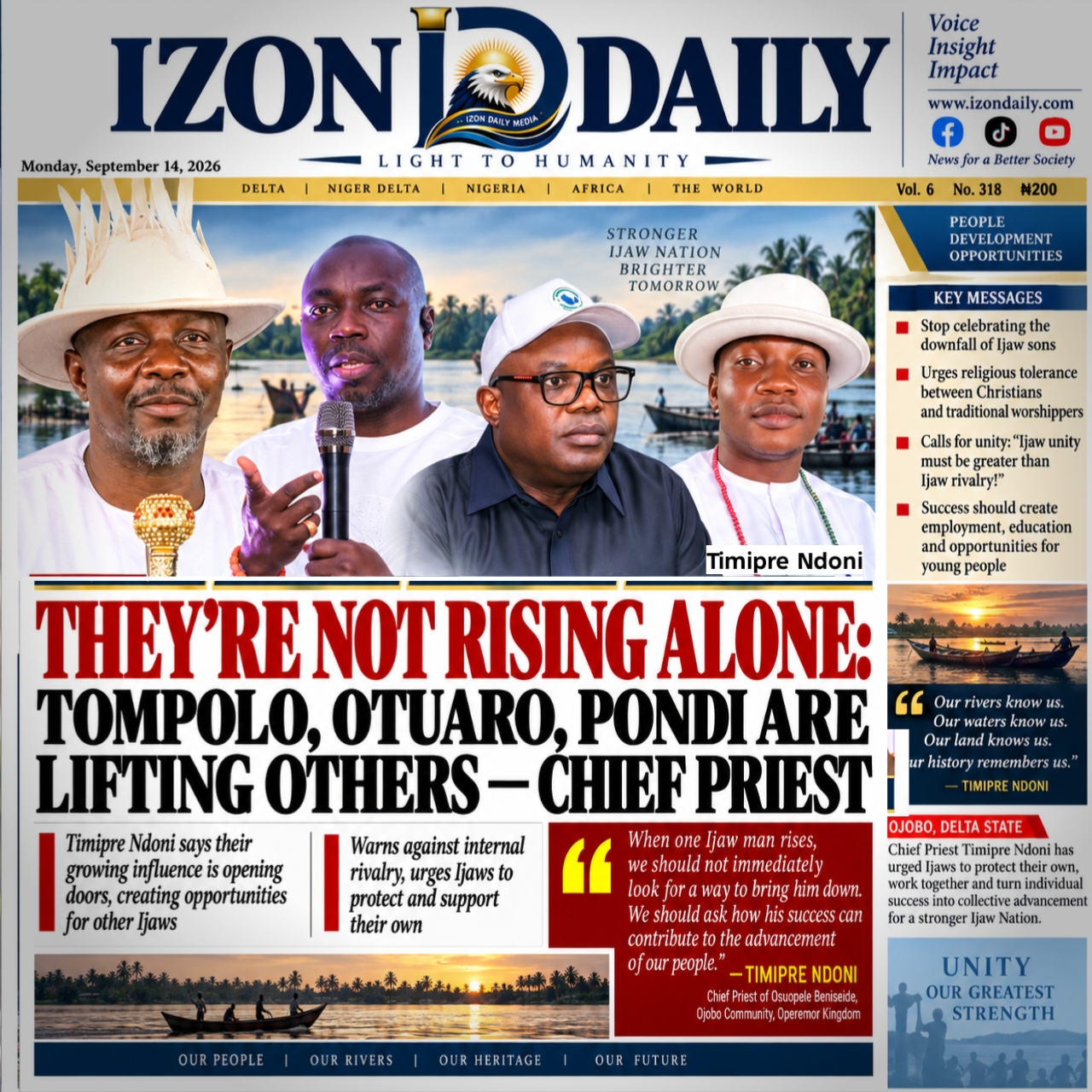
OJOBO, DELTA STATE — The Chief Priest of Osuopele Beniseide in Ojobo Community, Operemor Kingdom, Timipre Ndoni, has said the rise of High Chief Government Ekpemupolo, popularly known as Tompolo, Dr. Dennis Otuaro and Chief Kestin Pondi should not be viewed merely as the success of three individuals, but as a growing source of opportunities, empowerment and advancement for other Ijaw sons and daughters, declaring that “they are not rising alone; they are lifting others with them.”
Ndoni said the growing influence of the three Ijaw personalities has the potential to open doors for others, create opportunities for young people and strengthen the collective advancement of the Ijaw Nation, arguing that successful Ijaw sons should be encouraged to use their positions to raise more people rather than becoming targets of internal rivalry.
According to him, the true significance of an Ijaw son attaining influence is measured not merely by how high that individual rises, but by how many other people are able to rise through the opportunities, empowerment and platforms created along the way.
“When one Ijaw man rises, we should not immediately look for a way to bring him down. We should ask how his success can contribute to the advancement of our people,” Ndoni said.
He maintained that the progress recorded by Tompolo, Otuaro and Pondi should inspire a broader conversation about how influential Ijaw personalities can become ladders through which more young people, communities and future leaders find opportunities to advance.
The traditional priest consequently warned against attempts to pull down successful Ijaw personalities, declaring that political disagreements, personal interests and rivalries must not become stronger than the collective interest of the Ijaw Nation.
“At this point in our lives and at this stage in the history of our people, we need one another more than ever before,” he said.
Ndoni urged Ijaws to stop fighting and attempting to pull down their own people, stressing that Tompolo, Otuaro and Pondi remain sons of the Ijaw Nation regardless of political or personal disagreements surrounding them, and they should be supported in their drive for the social, political, and economic development of the Ijaw Nation, and the Niger Delta in general.
He argued that history had demonstrated the dangers of internal division, declaring that a divided people were easier to weaken while a united people would be difficult to ignore. “Our history teaches us one important lesson: a divided people are easier to weaken, but a united people are difficult to ignore,” Ndoni said.
‘STOP CELEBRATING THE DOWNFALL OF IJAW SONS’
The Chief Priest particularly cautioned against what he described as the tendency of some people to celebrate the difficulties or downfall of successful Ijaw personalities, arguing that the destruction of individuals who are positioned to create opportunities for others could ultimately hurt the wider society.
Speaking on Tompolo, Ndoni described the Niger Delta leader as a symbol of resistance and resilience to many Ijaws, arguing that his journey from armed agitation to his present involvement in security, peace-building, empowerment and community development had influenced public perceptions of him.
“His present influence is not simply about one man. It is about what he represents to many people: the belief that an Ijaw son can rise from the creeks and become a voice that cannot easily be ignored,” he stated.
Ndoni maintained that the success of prominent Ijaw personalities should therefore be considered in terms of how it contributes to the advancement of the wider Ijaw Nation rather than becoming a reason for internal conflict.
He said the objective should be to ensure that one person’s rise creates room for hundreds and ultimately thousands of others to rise, particularly through employment, education, empowerment, mentorship, community development and greater access to opportunities.
For Ndoni, this represents the larger significance of the growing influence of Tompolo, Otuaro and Pondi — that their positions should serve not only themselves but become platforms from which other Ijaw sons and daughters can advance.
He nevertheless stressed that supporting successful Ijaw leaders does not mean shielding them from criticism or accountability.
“We may disagree with our leaders. We may criticise them. We may hold them accountable. But disagreement should never become an excuse for destroying ourselves,” Ndoni declared.
CHIEF PRIEST SENDS MESSAGE TO IJAW CHRISTIANS
Ndoni also used the statement to call for religious tolerance between Ijaw Christians and adherents of traditional religion. He expressed concern over what he described as ridicule and derogatory comments directed at Ijaw traditional worshippers by some Christians, insisting that traditional religious practices form part of the historical and cultural heritage of the Ijaw people.
“There are Christians who ridicule Ijaw Traditional Worshippers, describe us as ignorant or primitive, and insult our spiritual practices whenever they have the opportunity. This must stop,” he said.
The Chief Priest stressed that his intervention was not intended to provoke religious confrontation but to encourage peaceful coexistence and mutual respect.
“You have the right to worship according to your faith, and we have the same right to practise and preserve ours. We are not ashamed of who we are,” Ndoni stated.
He said traditional worshippers commune with and speak directly to “Woyin” according to spiritual traditions handed down through generations, describing the practice as sacred to its adherents and deserving of respect.
“This is not a call for religious conflict. It is a call for mutual respect, religious tolerance and Ijaw unity,” he said.
Ndoni urged Christian Ijaws to freely practise Christianity while allowing traditional worshippers to preserve their ancestral faith, insisting that freedom of conscience should be respected across the Ijaw Nation.
‘ONE IJAW, ONE DESTINY’
The Chief Priest concluded with an appeal for Ijaws across political, religious and geographical divides to prioritise their common heritage and collective future, insisting that the success of one Ijaw person should become an opportunity to advance many others.
“Our rivers know us. Our waters know us. Our land knows us. Our history remembers us,” he declared.
“Let us stop pulling one another down. Let us protect our own. Let us respect our differences. Let us preserve our heritage. Let us defend the dignity of the Ijaw Nation.”
Ndoni further warned against Ijaws being used against one another, saying political differences and individual ambitions should never become greater than their collective destiny.
“No man should celebrate the downfall of an Ijaw man. No Ijaw man should become a weapon against another Ijaw man. Our differences should not destroy our common destiny,” he said.
He ended the statement with the declaration: “Ijaw unity must be greater than Ijaw rivalry! One Ijaw, One Destiny.”
The statement was signed by Timipre Ndoni, Chief Priest of Osuopele Beniseide, Ojobo Community, Operemor Kingdom.