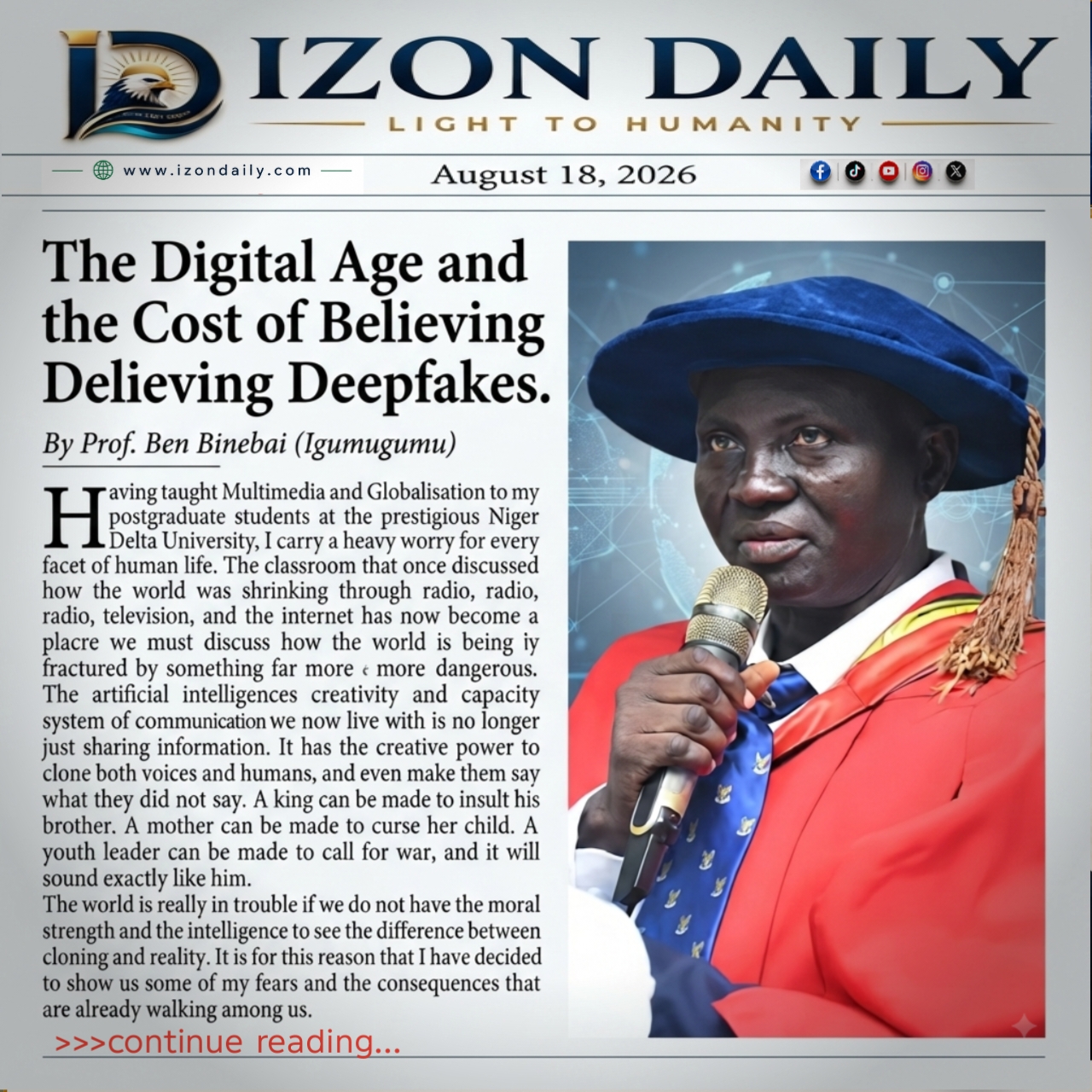
Having taught Multimedia and Globalisation to my postgraduate students at the prestigious Niger Delta University, I carry a heavy worry for every facet of human life. The classroom that once discussed how the world was shrinking through radio, television, and the internet has now become a place where we must discuss how the world is being fractured by something far more dangerous. The artificial intelligence generative creativity and capacity system of communication we now live with is no longer just sharing information. It has the creative power to clone both voices and humans, and even make them say what they did not say. A king can be made to insult his brother. A mother can be made to curse her child. A youth leader can be made to call for war, and it will sound exactly like him. The world is really in trouble if we do not have the moral strength and the intelligence to see the difference between cloning and reality. It is for this reason that I have decided to show us some of my fears and the consequences that are already walking among us.
The digital age arrived with a promise. It promised that every voice could be heard, that every story could be stored, that distance would no longer kill truth. A boy in Oporoza can now speak and a girl in Toronto can hear him in the same second. A king in Benin can bless his people and the blessing can travel to every phone in the diaspora before the kola nut is even cut. This is the miracle we were given. But inside that same miracle, another machine was built. It does not shout. It does not march. It whispers, and it wears your face while it does.
We call it deepfake. It is artificial intelligence trained to copy a person’s face, voice, walk, and mannerisms until even the person’s own mother will pause before she says, “that is not my son.” Ten seconds of video and one clear photo are enough. Two minutes on a phone are enough to make a monarch insult his neighbor, to make a pastor curse his church, to make a leader announce what he never announced. The technology itself is not evil. A knife can cut yam and it can cut skin. The problem is believability. For ten thousand years human beings have trusted their eyes. “I saw it,” was the end of argument in the village square. “I heard it with my own ears,” closed every case under the palaver tree. Now the eyes are being lied to in high definition, and the ears are being lied to in perfect pidgin, and our brains have not yet learned a new reflex.
Right now, on social media, the artificial world competes with the real world. The artificial intelligence has created its own world that is breaking the boundaries of reality. In that world, time can be reversed. A dead elder can be made to speak again. A war that never happened can be staged with smoke, sound, and tears. A peace meeting that never took place can be invented to deceive a community. The algorithms reward what shocks, what divides, what bleeds, and so the artificial world is not built to tell the truth. It is built to hold attention. And because it is faster than truth, it arrives first. By the time the real king comes out to deny, ten thousand people have already believed, shared, and fought over the lie. By the time the real video is uploaded, the fake one has already shaped opinion. We are no longer just fighting falsehood. We are fighting a parallel reality that looks more polished, more dramatic, and more convenient than our own. Children growing up now will not know if the history they watched on their phone actually happened, or if it was generated last night in a room somewhere. That is how dangerous believability has become.
There is an old tale our fathers told about a trickster spirit who learned to steal faces. He would take the face of the chief, wear it to the market, and start quarrels. He would take the voice of the mother and call her children to the bush. He would take the walk of the warrior and lead the young men into ambush. The village did not fall because the spirit was stronger than them. It fell because the people stopped trusting each other. They began to ask, “Is this truly our chief? Is this truly my brother?” And once doubt entered the compound, the spirit did not need to fight anymore. The people fought themselves. This is what deepfakes have become in our time. They are that same trickster spirit, but now it does not need to hide in the forest. It lives in our phones. It borrows our faces, borrows our voices, and sets brother against brother until we forget what our real voice sounds like. The consequence is not just one lie. The consequence is that a people lose the ability to believe anything, even the truth when it finally comes.
The consequence of that believability is already walking among us. It does not wear uniform. It comes as a WhatsApp forward at 2am. It comes as a TikTok clip with angry music. It comes as a voice note that sounds exactly like your uncle. First it kills individuals. A young woman is put in a video she never acted. By morning her name is trending and by evening her family has stopped answering calls. Even when the video is proven fake a week later, the shame does not delete. The internet does not forget. It keeps the ghost. Then it kills relationships. A fake voice of “your brother said you are a fool” is sent to a group chat. Brothers who ate from the same pot stop speaking. Cousins who were supposed to build one house together start building two fences.
But the wound goes deeper when it touches a people. For a community, personality is not a luxury. Personality is memory. It is the way we greet, the way we settle quarrel, the way we name our children, the way we speak to our kings. When deepfakes enter that space, they attack the memory directly. Imagine a clip of an Ijaw Amayanabo cursing a Benin Duke. It is not real. But the youths who see it do not wait for the palace to issue a statement. They are already angry. They are already typing. They are already planning how to defend honor. By the time the elders gather, the fire has moved from the phone to the street. Imagine a fake video of an elder saying, “our history says this land was never ours.” Children who have never sat with their grandfather to hear the real story will now quote the fake one, because the fake one came with subtitles and 2 million views. In this way a people can lose their history without losing a single war.
The digital age also attacks authority. In the past, to speak against a king you had to stand in his court. People would see your face. The chiefs would hear your tone. There was consequence. Today you can sit in another country, put the king’s face on another body, and make him say anything. When that happens twice, people stop trusting even the real videos from the palace. They say, “how do we know this one is real?” And once you doubt the voice of the stool, you doubt the stool itself. A kingdom that does not trust its head cannot walk straight. A nation that does not trust its elders cannot raise children correctly.
Economically, the damage is quiet but heavy. Investors watch the timeline. If they see a fake video of “violence in the Niger Delta” they pull their money before asking if it is real. If they hear a cloned voice of a CEO approving a transfer, they send money to a thief. If they see a fake clip of a candidate during election, they vote with fear instead of fact. One lie can move markets. One lie can move votes. One lie can move young men from their farms into the street.
Why does it work so well? Because we are human. We are built to believe what we see. And because the people who make deepfakes know our weaknesses. They use our language. They use our music. They use our pain points. They know that an ethnic insult will spread faster than a peace message. They know that anger is cheaper than data. They know that most people will share first and ask questions later, because sharing feels like doing something.
But the digital age did not only give us the weapon. It also gave us the shield. The same phone that can spread a lie can spread a truth. The same AI that can clone a voice can record a thousand elders before they pass. The same internet that can divide a kingdom can connect all the sons and daughters of that kingdom across the world. The question is not whether the technology will stay. It will. The question is who will be faster, who will be wiser, who will be more organized.
We must begin with the home. Every parent, every teacher, every pastor, every youth leader must teach one new rule: pause before you share. If a video makes you angry in ten seconds, wait ten minutes. Check the source. Check the palace page. Check with two elders. Teach our children that “I saw it” is no longer evidence. Teach them to ask, “who benefits from my anger?” In the same way we taught them not to eat food from strangers, we must teach them not to eat information from strangers.
Then the palaces must move to the timeline. Kings and elders of honour cannot afford to be offline. If a fake video comes out on Monday, the real king must be on camera on Tuesday, speaking in his own voice, from his own throne, with his council behind him. The people need to know what the real voice sounds like so that when a fake one comes, their spirit will reject it. We need a council of verification. Not police. Elders. People whose faces are already known, who can say, “this is not our son.” When the people see that the stool is active online, they will run to the stool instead of running to the comment section.
We must also archive ourselves aggressively. Record the real festivals. Record the real oral histories. Record the real voices of the grandmothers singing the old songs. Put them in places where they cannot be deleted. When a fake history appears in ten years, we will have the original to place beside it. Truth needs evidence, and evidence needs storage.
Finally, we must remember who we are. A people’s personality is not in their oil, and not in their population, and not in their hashtags. It is in how they treat each other when no one is watching. It is in how they forgive. It is in how they listen to elders before they pick up a stone. Deepfakes want to steal that personality and replace it with outrage. They want us to become a people that reacts first and thinks later. If we allow that, we will wake up one day and not recognize ourselves.
The digital age is not going backward. But believability is a choice. We can choose to believe the lie because it is fast, or we can choose to believe the truth because it is ours. We can choose to let algorithms define what an Ijaw is, what a Benin is, what a Yoruba is, or we can define ourselves by sitting down, as we have always done, and speaking to each other with respect. The palaver tree has moved. It is now on our phones. Let the kings come there. Let the elders speak there. Let the youths listen there. Let us fill the space with real voices so that there is no room for fake ones. If we do not protect our image, someone else will paint it for us. And they will not paint us with love.