
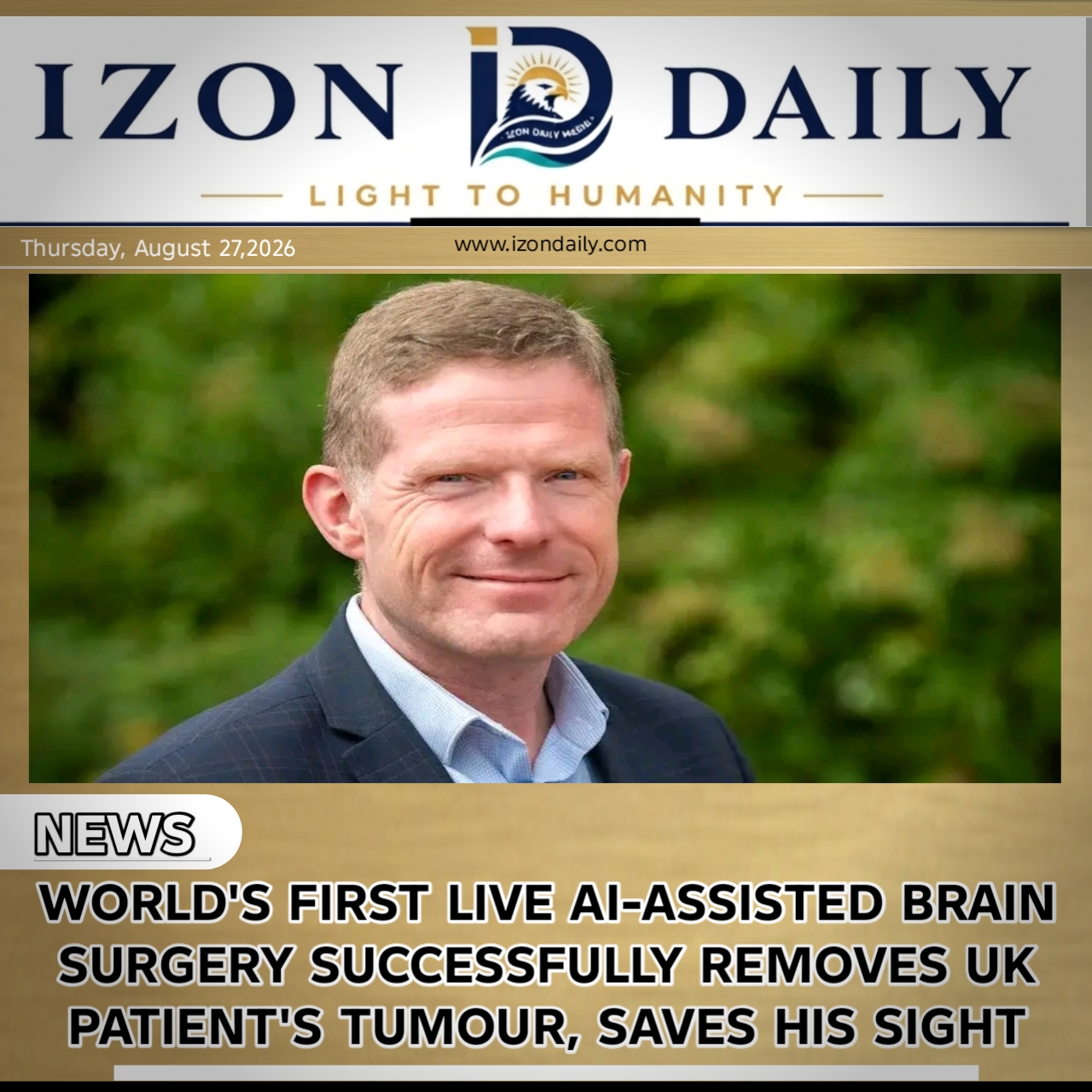
A father-of-two from Bedfordshire has become the world's first patient to undergo brain surgery with live artificial intelligence assistance, in a groundbreaking procedure that successfully removed his tumour and prevented him from losing his sight.
Rhys Hibbert, 48, a customer services manager, had the surgery performed by neurosurgeons at University College London Hospital using a specially developed AI tool that analysed a live video feed of the operation, guiding the surgical team around delicate but hidden vessels and nerves in the brain to safely extract as much of the tumour as possible.
"From a patient safety perspective, I can see absolutely the benefit. There are no road signs inside our head," Hibbert said, describing the value of the technology.
Until 18 months ago, Hibbert was healthy and active, taking daily two-mile walks during his lunch breaks. That changed when he collapsed and began fitting while out on one such walk. A subsequent brain scan revealed an 11mm non-cancerous tumour growing on his pituitary gland, a small hormone-secreting organ at the base of the skull positioned dangerously close to the carotid arteries and optic nerves.
As the tumour grew, it began pressing on his optic nerves, gradually narrowing his peripheral vision. He also developed severe fatigue, dizziness and balance problems, though he described the emotional and psychological toll of the illness as the hardest part of the experience, including his reluctance to feel like a burden to loved ones despite their willingness to help.
When surgeons offered him the opportunity to be the first patient to trial the procedure with their bespoke AI tool, Hibbert did not hesitate, saying patient participation in research was essential for medicine to advance.
The operation involved inserting an endoscope, a thin camera mounted on a flexible tube, through the nose to reach the base of the skull, where the tumour lay hidden behind layers of bone and tough membrane. Because human anatomy varies from person to person, pinpointing the safest extraction point was far from straightforward. Ordinarily, such procedures carry a 25 to 50 percent chance of the tumour not being fully removed, and a 0.5 to 2 percent risk of injury to a major blood vessel.
This is where the AI system proved valuable. Displayed on a second screen during the operation, it analysed the live footage in real time, tracked surgical instruments, and flagged the likely locations of critical vessels and nerves, helping surgeons identify the safest areas to operate. Researchers likened its function to facial recognition technology, only trained to detect vital, often concealed anatomical structures rather than faces.
Professor Hani Marcus, who helped carry out the procedure, explained that the tool had been trained on hundreds of previous pituitary tumour removal videos, giving it exposure to far more cases than most surgeons encounter in a lifetime. He described it as functioning like "an expert second pair of eyes" in the operating theatre, distinguishing it from other experimental AI tools by its ability to work in real time.
The research team, which developed the technology with backing from the National Institute for Health and Care Research and Google, stressed that the AI remains strictly an assistive tool, with surgeons retaining full control throughout the procedure. Their long-term goal is to build a kind of "surgical ChatGPT" that gives doctors an additional expert opinion they can consult or disregard as they see fit.
Following years of laboratory testing, the team says the technology's real-world debut has been encouraging, and they are now preparing for a larger clinical trial.
For Hibbert, the results have been transformative. "When I opened my eyes after the operation it felt like I had got 360-degree vision. I hadn't seen that clearly for a year," he said. In the eight weeks since his surgery, his sight has continued to improve, his energy has returned, and the symptoms that plagued him before the operation have disappeared entirely. "It's given me my life back," he added.
Health innovation minister James Frith welcomed the outcome, describing Hibbert's experience as "life-changing surgery" made possible through government-funded research, while stressing the importance of maintaining proper safeguards as AI becomes more embedded in medical practice.
#IzonDaily
#AIinHealthcare #BrainSurgery #MedicalInnovation #UCLH #ArtificialIntelligence #NHS #MedicalBreakthrough #HealthTech #UKNews #PituitaryTumour #SurgicalInnovation #ScienceNews