
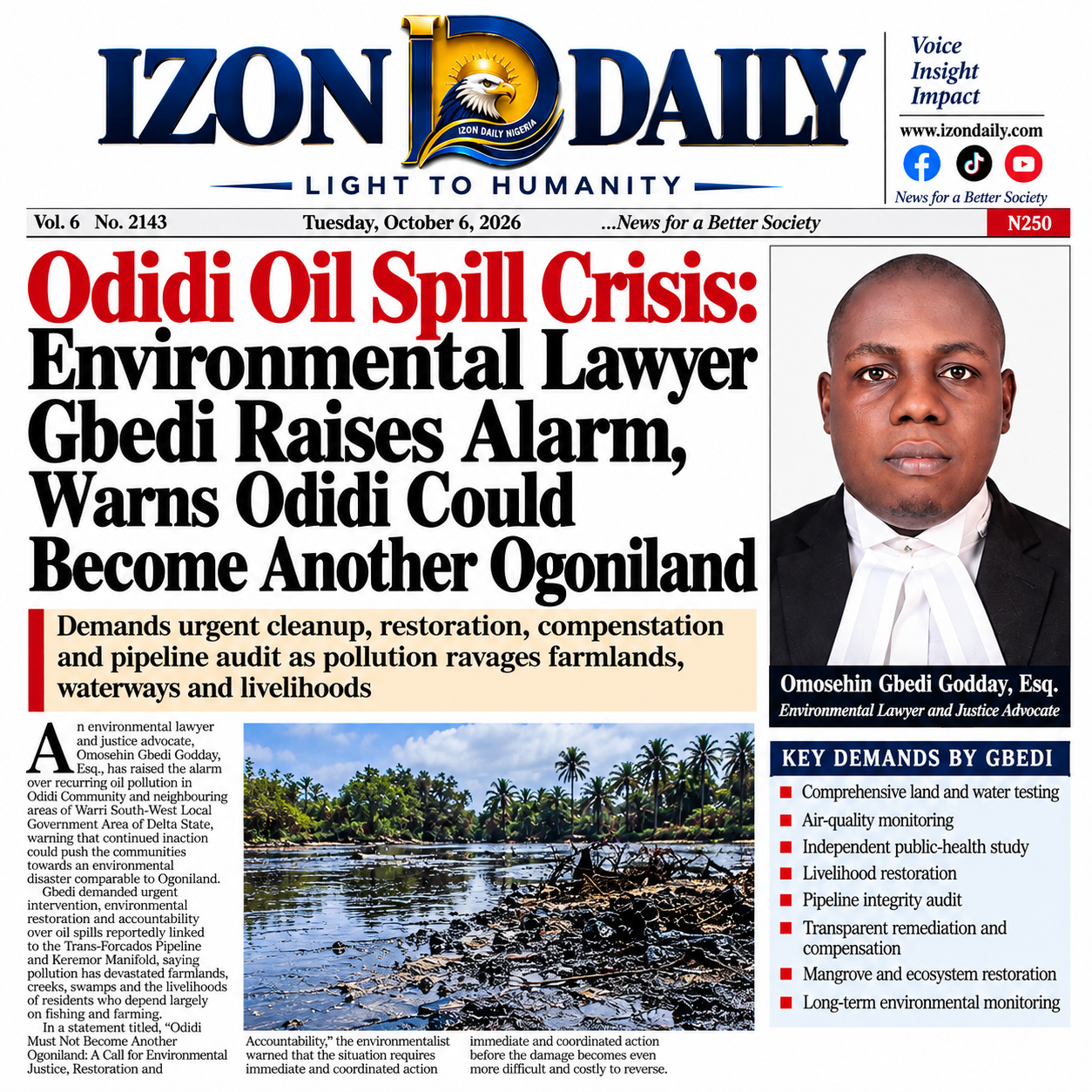
An environmental lawyer and justice advocate, Omosehin Gbedi Godday, Esq., has raised the alarm over recurring oil pollution in Odidi Community and neighbouring areas of Warri South-West Local Government Area of Delta State, warning that continued inaction could push the communities towards an environmental disaster comparable to Ogoniland.
Gbedi demanded urgent intervention, environmental restoration and accountability over oil spills reportedly linked to the Trans-Forcados Pipeline and Keremor Manifold, saying pollution has devastated farmlands, creeks, swamps and the livelihoods of residents who depend largely on fishing and farming.
In a statement titled, “Odidi Must Not Become Another Ogoniland: A Call for Environmental Justice, Restoration and Accountability,” the environmentalist warned that the situation requires immediate and coordinated action before the damage becomes even more difficult and costly to reverse.
According to Gbedi, the Trans-Forcados Pipeline was commissioned in 1971, making it about 54 years old at the time of a reported September 2025 spill and 55 years old when another spill was first observed on February 19, 2026.
He stressed, however, that the age of the pipeline alone does not establish the cause of the spills, which must be determined through Joint Investigation Visits and appropriate technical investigations.
Nevertheless, he argued that repeated incidents involving ageing oil infrastructure raise serious questions about inspection, maintenance, integrity testing and possible replacement.
‘𝗢𝘂𝗿 𝗪𝗮𝘁𝗲𝗿𝘀 𝗔𝗿𝗲 𝗣𝗼𝗹𝗹𝘂𝘁𝗲𝗱, 𝗢𝘂𝗿 𝗖𝗿𝗼𝗽𝘀 𝗔𝗿𝗲 𝗗𝘆𝗶𝗻𝗴’
The September 2025 spill reportedly affected farmlands, swamps and creeks, disrupting the economic activities of farmers and fishermen.
Odidi Community Chairman, Preye Okrikpa, was quoted as lamenting the impact of the pollution on residents.
“Our waters are polluted, our crops are dying, and we are left with little to sustain ourselves,” he said.
Gbedi also drew attention to a protest reportedly staged by women of Odidi at the operational facility of Heritage Energy Operational Services Limited (HEOSL).
Protest leader Nancy Adowarebi reportedly said the pollution had created severe hardship for women and families in the affected area.
“Many of them are sick and starving to death because in the morning, the women cannot cook with firewood until the tide goes down,” she was quoted as saying.
𝗛𝗲𝗮𝗹𝘁𝗵 𝗖𝗼𝗻𝗰𝗲𝗿𝗻𝘀 𝗗𝗲𝗺𝗮𝗻𝗱 𝗜𝗻𝗱𝗲𝗽𝗲𝗻𝗱𝗲𝗻𝘁 𝗜𝗻𝘃𝗲𝘀𝘁𝗶𝗴𝗮𝘁𝗶𝗼𝗻
Addressing reported health concerns among residents, Gbedi maintained that specific allegations, including reports of miscarriage, require independent verification.
He nevertheless said existing research on exposure to petroleum pollution has raised concerns about possible adverse health outcomes, making comprehensive medical and environmental assessments necessary.
He therefore called for independent public health investigations to determine the extent of residents’ exposure and identify any associated health consequences.
‘𝗗𝗼𝗻’𝘁 𝗟𝗲𝘁 𝗢𝗱𝗶𝗱𝗶 𝗕𝗲𝗰𝗼𝗺𝗲 𝗔𝗻𝗼𝘁𝗵𝗲𝗿 𝗢𝗴𝗼𝗻𝗶𝗹𝗮𝗻𝗱’
Gbedi warned authorities against allowing the situation to deteriorate into a prolonged environmental crisis similar to the pollution experienced in Ogoniland.
He recalled that the 2011 United Nations Environment Programme environmental assessment of Ogoniland recommended an initial $1 billion for the first five years of restoration and estimated that environmental recovery could take between 25 and 30 years.
He also criticised situations in which oil-spill investigations are conducted without adequate follow-up in containment, remediation and compensation.
Citing historical NOSDRA data covering January 2010 to August 2015, he said remediation was recorded at only 229 sites despite thousands of reported oil-spill incidents during the period.
𝗟𝗮𝘄𝘆𝗲𝗿 𝗗𝗲𝗺𝗮𝗻𝗱𝘀 𝗘𝗺𝗲𝗿𝗴𝗲𝗻𝗰𝘆 𝗔𝗰𝘁𝗶𝗼𝗻
To prevent further environmental deterioration, Gbedi called on the National Oil Spill Detection and Response Agency (NOSDRA), Nigerian Upstream Petroleum Regulatory Commission (NUPRC), National Environmental Standards and Regulations Enforcement Agency (NESREA), Delta State environmental authorities, HEOSL, and representatives of the affected Odidi, Kantu and Keremor communities to establish a coordinated intervention programme.
He said the response should involve independent scientists, environmental experts, public-health professionals and civil-society organisations to guarantee credibility and transparency.
Among the urgent measures demanded are comprehensive land and water testing, air-quality monitoring, independent public-health studies, livelihood restoration, pipeline-integrity audits, transparent remediation and compensation, mangrove and ecosystem restoration, and long-term environmental monitoring.
Gbedi insisted that Nigeria’s environmental and petroleum laws must produce tangible improvements in the lives of oil-producing communities.
“The laws — Petroleum Industry Act 2021, NOSDRA Act, NESREA Act, EIA Act — must translate into measurable outcomes. The success of regulatory institutions is not measured by policy sophistication but by whether people have safe drinking water, farmable land and healthy rivers,” he said.
𝗛𝗲 𝗰𝗼𝗻𝗰𝗹𝘂𝗱𝗲𝗱 𝘄𝗶𝘁𝗵 𝗮 𝘀𝘁𝗿𝗼𝗻𝗴 𝗮𝗽𝗽𝗲𝗮𝗹 𝗳𝗼𝗿 𝗶𝗺𝗺𝗲𝗱𝗶𝗮𝘁𝗲 𝗮𝗰𝘁𝗶𝗼𝗻.
“Environmental protection is not a favour to an oil-producing community. It is a responsibility. Odidi deserves restoration, not abandonment.”
#OdidiOilSpill #OdidiMustNotBecomeAnotherOgoniland #EnvironmentalJustice #OilPollution #NigerDelta #DeltaState #WarriSouthWest #TransForcadosPipeline #HEOSL #NOSDRA #NUPRC #NESREA #OgonilandCleanup #ClimateJustice #OilSpillCrisis #IzonDaily